TL;DR
The Problem:
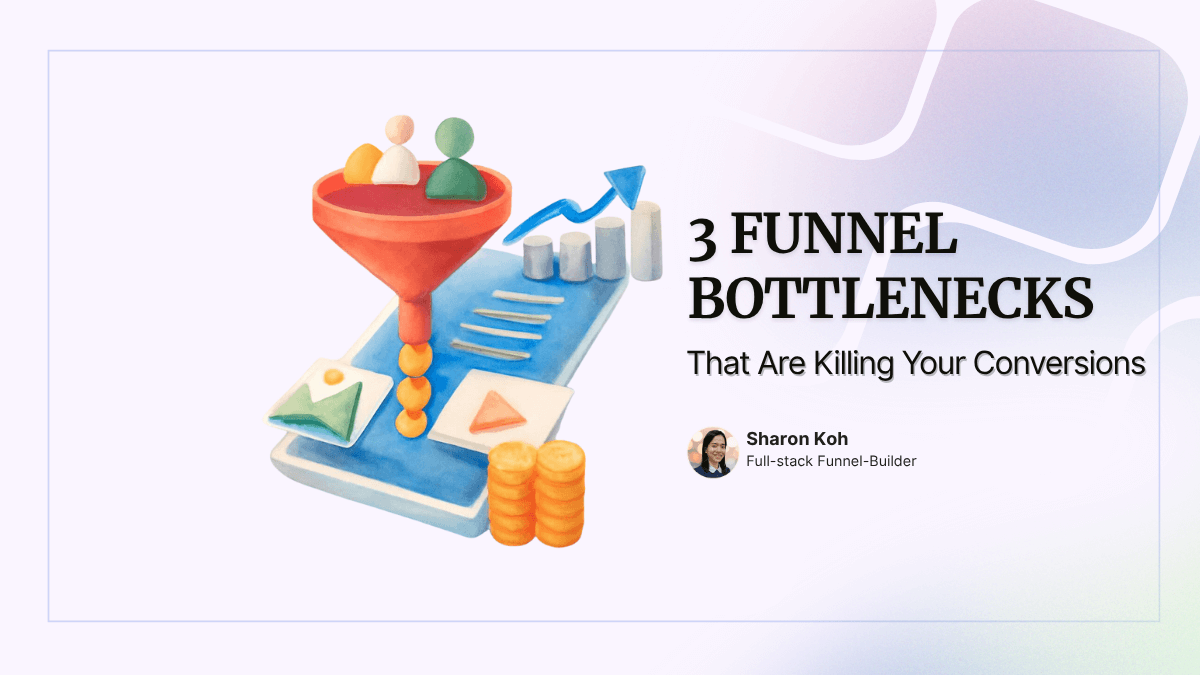
96% of visitors leave without converting at 3 critical bottleneck points
Bottleneck #1 – Traffic Mismatch:
You’re attracting the wrong people
Fix: Target buyer-intent keywords, tighten audience targeting
Bottleneck #2 – Information Gap:
Prospects can’t find answers to their questions
Fix: Add FAQ, show pricing, create case studies
Bottleneck #3 – Decision Stage Friction:
Complicated forms and slow pages kill checkouts
Fix: Cut form fields, add trust badges, optimize speed
Action Plan:
Find your biggest drop-off point
Implement quick wins first
Fix the funnel before scaling traffic
Table of Contents
Introduction

Have you ever felt like you’re pouring money into a leaky bucket? That’s the reality for most coaches and course creators who are driving traffic but not seeing the client bookings or course sales they expected. Your funnel might have more holes than you realize, and each one is costing you potential clients.
Here’s a stat that’ll blow your mind: According to Ruler Analytics‘ analysis of over 100 million data points, the average conversion rate across all fourteen industries is 2.9%- meaning 97 out of 100 visitors leave without converting. That means only 3 out of 100 people are actually taking action! But here’s the kicker- most of those losses happen at just three critical bottleneck points in your funnel.
Many coaches are spending $2,000-$5,000 per month on Facebook ads or creating tons of content, but their discovery call bookings are inconsistent, their show-up rates are terrible, or their sales calls aren’t converting. If you’re wondering why your funnel isn’t converting, the answer usually lies in one of these three critical bottlenecks we’ll cover today.
Here’s what a typical broken coaching funnel looks like:
- You drive 1,000 people to your website or landing page
- Only 200 actually engage with your content (80% drop off immediately)
- Just 20 book a discovery call (90% of engaged visitors don’t take action)
- Only 12 actually show up to the call (40% no-show rate)
- And maybe 3-4 become paying clients (25-33% close rate)
That’s a 0.3-0.4% overall conversion rate- meaning you need to drive massive traffic just to get a handful of clients.
But what if I told you that most coaches have ONE major bottleneck that’s killing 50-70% of their potential conversions? Fix that one thing, and suddenly you’re getting 2-3x more clients from the same amount of traffic and ad spend.
In this guide, I’m gonna walk you through the three biggest funnel bottlenecks that are probably destroying your conversion rates right now, and more importantly, I’ll show you exactly how to fix them. These aren’t theoretical problems- these are the actual issues I see killing conversions for coaches and course creators every single day, and they’re costing you way more money than you think.
The three bottlenecks we’ll cover:
- Traffic Mismatch (Awareness Stage) – You’re attracting the wrong people who were never going to buy
- Information Gap (Consideration Stage) – Prospects can’t find the answers they need to say yes
- Form Friction (Decision Stage) – Your booking or checkout process is too complicated
By the end of this article, you’ll know exactly which bottleneck is hurting you most and how to fix it – so you can finally get more clients without spending more on ads.
Understanding Funnel Bottlenecks and Why They Matter

Okay, so let me start by explaining what a funnel bottleneck actually is, because this concept is crucial for coaches and course creators who want to grow without burning through their ad budget.
Once you understand the basic structure of a sales funnel for coaches, you can identify exactly where your bottlenecks are occurring
A funnel bottleneck is a specific point in your client journey where people are dropping off at an unusually high rate compared to the previous step. Think of it like traffic on a highway- everything’s flowing fine until you hit that one spot where three lanes merge into one, and suddenly you’ve got a massive backup. That’s your bottleneck.
Each of the three main coaching funnel stages – awareness, consideration, and decision- has its own unique bottleneck challenges. Understanding which stage is causing your biggest drop-off is the first step to fixing it.
The difference between a bottleneck and just general conversion problems is huge. General conversion issues are like having a slow leak in your tire- annoying, but manageable. Bottlenecks are like having a giant nail stuck in there- you’re losing pressure fast, and if you don’t fix it, you’re going nowhere.
Here’s what this looks like for coaches:
Your funnel might look like this:
- 1,000 people visit your website (from ads, social media, etc.)
- 300 people watch your video or read your sales page (30% engagement)
- 50 people click “Book a Discovery Call” (16% of engaged visitors)
- 30 people actually show up to the call (60% show-up rate)
- 10 people become paying clients (33% close rate)
In this example, you’ve got bottlenecks at multiple stages, but the biggest one is between watching your content and booking a call- you’re losing 84% of engaged prospects at that single point.
The Revenue Impact for Coaches:
The scary part is how much revenue these bottlenecks cost you. Let’s do some quick math with real coaching numbers.
Say you’re getting 1,000 website visitors per month and your coaching package is $3,000. If your current funnel converts at 1% (which is common for coaches), that’s 10 new clients per month = $30,000 in monthly revenue.
But if you’ve got a bottleneck cutting your conversion rate in half at just one stage, you’re losing 5 potential clients every single month. That’s $15,000 per month, or $180,000 per year- literally evaporating because of one fixable problem.
And here’s the thing that nobody talks about enough: bottlenecks have a compounding effect. If you’ve got issues at multiple stages of your funnel, they multiply against each other. It’s not additive; it’s multiplicative.
Example of compounding bottlenecks:
- If your ad-to-landing page conversion is 50% (losing half)
- And your landing page-to-booking conversion is 50% (losing half again)
- And your call show-up rate is 50% (losing half again)
- You’re not losing 50% + 50% + 50% = 150% total
- You’re losing 50% × 50% × 50% = you’re only converting 12.5% of your original traffic!
That’s why fixing even one major bottleneck can have such a dramatic impact on your bottom line. Fix that call show-up rate from 50% to 80%, and suddenly you’re converting 20% instead of 12.5%- that’s a 60% increase in clients without spending another dollar on ads!
The Biggest Mistake Coaches Make:
The biggest mistake coaches make is focusing on getting more traffic instead of fixing their funnel first. I see this all the time- coaches spending $2,000-$5,000/month on Facebook ads when they have a 30% no-show rate for discovery calls and a broken sales process.
It’s like being a fisherman with a torn net, wondering why you aren’t catching more fish. More fish aren’t the problem- the holes in your net are the problem!
Here’s the smart approach:
Instead of spending $3,000 on more ads this month, invest that time and money into:
- Identifying your biggest bottleneck (usually booking-to-show or call-to-close)
- Fixing that one thing
- Measuring the improvement
- Then scaling your ad spend with a funnel that actually works
When you fix a funnel bottleneck, you’re essentially giving yourself a permanent raise. Every future visitor, every future ad dollar, every future piece of content you create will now convert better. That’s leverage.
Real Numbers That Matter:
While specific benchmarks vary widely by niche and business model, tracking your own baseline numbers is crucial. Monitor your conversion rates at each stage- from website visit to engagement, engagement to booking, show-up rates, and close rates- to identify your biggest bottleneck.
If your numbers are significantly worse than these at any stage, that’s your bottleneck. Fix it before you scale.
Bottleneck #1 : The Awareness Stage Traffic Mismatch

This bottleneck happens when you’re driving traffic to your site, but it’s the wrong kind of traffic. The average bounce rate across all sectors is 44.04% (Oberlo), but when there’s a traffic mismatch, those numbers can shoot up significantly.
Here’s what a traffic mismatch looks like for coaches and course creators:
You’re running Facebook ads targeting “entrepreneurs” or “small business owners,” but your actual offer is a $10,000 high-ticket mastermind for established 6-figure businesses. Or you’re getting tons of organic traffic from a blog post about “free business tips,” but your entire business model is selling premium coaching packages. See the disconnect?
Another common example: You’re targeting “how to start a business” keywords, but your coaching program is designed for people who are already in business and want to scale from $100K to $500K. These brand-new entrepreneurs aren’t your ideal clients- they can’t afford you and aren’t ready for your level of support.
The problem is that broad, cheap keywords often bring unqualified visitors. Keywords like “how to make money” or “free business advice” might get lots of clicks at a low cost per click, but if those visitors are broke, tire-kickers, or DIY-only types, your conversion rate tanks.
How to Diagnose If This Bottleneck Is Killing You:
First, check your bounce rate by traffic source in Google Analytics. According to current bounce rate statistics, 70% or more is the first alarm bell (Claspo). If certain channels consistently show bounce rates above 60%, that’s a warning sign your traffic quality is poor.
Second, look at time on page for new visitors. If people are spending less than 30 seconds on your landing page before bouncing, they’re not even reading your content. They took one look, realized this wasn’t what they expected, and left. That’s textbook traffic mismatch.
Third- and this is crucial- compare your cost per qualified lead across different traffic sources. If one channel costs $150 per booked discovery call while another costs $30, that significant gap tells you where your qualified traffic is really coming from.
The Fix for This Bottleneck:
Stop chasing cheap clicks and start pursuing qualified prospects. Here’s the strategic approach:
Overhaul your targeting to focus on buyer intent, not curiosity. Instead of targeting:
- “How to grow a business” (curiosity seekers) → Target “business growth coach” or “scale to 7 figures coach” (buyers)
- “Free marketing tips” (freebie seekers) → Target “marketing coaching for consultants” (buyers)
- “How to get clients” (beginners) → Target “client acquisition system for coaches” (your actual audience)
Traffic source quality matters enormously. Different platforms and channels produce dramatically different conversion rates, showing how critical it is to focus on high-intent traffic sources rather than just chasing cheap clicks.
Use better audience targeting on paid ads. Instead of broad targeting like:
- “Entrepreneurs interested in business”
- “Small business owners”
- “People interested in self-improvement”
Try specific targeting like:
- People who follow specific high-ticket coaches in your niche
- Audiences who’ve engaged with coaching/course content in the past 30 days
- Lookalike audiences based on your current paying clients
- LinkedIn targeting for specific job titles, company sizes, or industries
Implement message matching– make sure your ad copy, landing page headline, and offer all use the same language and promise the same thing. If your ad says “Book a free strategy call,” your landing page better say “Book Your Free Strategy Call” right at the top, not “Buy my $5,000 program now.” This consistency reduces cognitive dissonance and improves conversion.
Add qualifying language in your ads and content. Be specific about who you serve:
- “For coaches making $5K-$10K/month who want to scale to $30K+”
- “For course creators who’ve already launched but need better systems”
- “Not for beginners- this is for established business owners only”
This filters out unqualified prospects before they even click, saving you money on wasted ad spend.
Use lead magnets that pre-qualify prospects. Instead of generic freebies like “10 Business Tips,” create lead magnets that attract your ideal client:
- “The $10K/Month Client Acquisition Framework” (attracts people ready to invest)
- “Scale to Multi-6-Figures Roadmap” (attracts people already making money)
- “Premium Client Attraction Checklist” (attracts people who want premium clients)
Focus on long-tail, high-intent keywords even if they have lower search volume. A keyword like “high-ticket sales coach for service providers” will bring fewer visitors than “business coach,” but those visitors are far more likely to convert because they’re looking for exactly what you offer.
Consider platform strategy. Different platforms attract different buyer intent:
- YouTube: Great for long-form educational content that builds trust, but lower immediate buyer intent
- LinkedIn: Higher buyer intent for B2B coaches and consultants
- Facebook/Instagram: Good for building community and nurture, medium buyer intent
- Google Search: Highest buyer intent if targeting the right keywords
- Podcast ads: High trust but requires longer nurture
Expected Results:
When you fix traffic mismatch issues, you should see:
- Your bounce rate decrease (from 70%+ to 40-50%)
- Your discovery call booking rate increase (even if traffic volume drops)
- More qualified calls (people who can actually afford you)
- Shorter sales cycles (less “I need to think about it”)
- Higher conversion rates from call to client
Quality always beats quantity when it comes to conversion optimization. It’s better to have 100 highly qualified visitors than 1,000 tire-kickers.
Bottleneck #2 : The Consideration Stage Information Gap
This bottleneck is sneaky because it doesn’t show up in your bounce rate. People are actually sticking around and engaging with your content, but then they just… disappear. They don’t bounce immediately, they don’t convert- they just ghost you.
The consideration stage is where people are actively evaluating whether your coaching or program is right for them. They’re past the awareness stage (they know they have a problem), and they’re trying to decide if you’re the one who can solve it. If you don’t answer their specific questions and objections during this stage, they’ll leave and never come back.
Understanding the Information Gap for Coaches:
The information gap is the difference between what your prospects need to know to make a decision and what you’re actually telling them. Common examples for coaches and course creators include:
- Hiding pricing information and forcing people to book a discovery call just to find out if they can afford your services
- Not explaining your coaching methodology or framework clearly
- Failing to address objections like “Will this work for my specific situation?” or “How much time will this require?”
- Not showing what the actual coaching process or course experience looks like
- Leaving vague details about program duration, session frequency, or level of support
Research shows that transparency matters. When prospects can’t find the information they need- like pricing ranges, time commitment, or what results to expect- they tend to abandon the buying process rather than reach out to ask.
How to Identify If You’ve Got an Information Gap Bottleneck:
Look at where people are spending time but not converting. Use tools like Hotjar or Microsoft Clarity to watch session recordings. You’ll see visitors scrolling up and down looking for something, hovering over certain sections, or scrolling back up to re-read parts. They’re searching for information you’re not providing.
Another diagnostic tool is exit-intent surveys. When someone’s about to leave your site, ask them: “What stopped you from booking a call today?” or “What information were you looking for?” The answers will reveal exactly what information gaps you need to fill.
The Fix for This Bottleneck:
Create a comprehensive FAQ section that addresses common objections. Put it prominently near your main offer. Questions like:
- “How much time will I need to commit each week?”
- “What if I’ve tried other programs and they didn’t work?”
- “Do you offer payment plans?”
- “What kind of support do I get between sessions?”
- “Is this right for someone in [specific industry/situation]?”
Show pricing transparency. You don’t need to list exact prices, but give ranges or starting points. For example: “Coaching packages start at $3,000 for three months” or “Payment plans available starting at $297/month.” This filters out people who can’t afford your services before they waste your time on a discovery call.
Use client success stories and testimonials specific to different situations. Instead of generic testimonials like “This coaching changed my life!”, showcase transformation stories from people with specific challenges:
- “How Sarah went from $5K to $20K months in 90 days”
- “How John transitioned from corporate to coaching with my framework”
- “How Maria overcame imposter syndrome and launched her course”
When someone sees a story that mirrors their situation, they think “That’s exactly like me- if it worked for them, it can work for me.”
Show behind-the-scenes of your process. Create a “What to Expect” page or video that walks through:
- What happens on a typical coaching call
- What the course modules look like inside
- How you deliver support between sessions
- What tools or platforms you use
- Timeline from enrollment to results
Address the “Yeah, but…” objections directly. Common ones for coaches:
- “Yeah, but I don’t have time” → Show how people with busy schedules make it work
- “Yeah, but I’m not tech-savvy” → Explain that everything is simple and you provide tech support
- “Yeah, but what if I fail?” → Share your guarantee, refund policy, or risk-reversal offer
- “Yeah, but I’ve tried other programs” → Explain what makes your approach different
Use comparison content strategically. Create content like:
- “DIY vs. Coaching: Which is right for you?”
- “How my program compares to [competitor approach]”
- “Group coaching vs. 1-on-1: Pros and cons”
This helps people self-qualify and shows you’re confident in your positioning.
Add video content to bridge information gaps. Record a 2-3 minute video showing:
- Your coaching philosophy and approach
- A quick walkthrough of your program structure
- What makes your methodology unique
- Who this is (and isn’t) for
Video builds trust faster than text and lets prospects get a feel for your personality and teaching style.
Implement progressive disclosure of information. Use accordion sections, tabs, or expandable content so people can dig deeper into areas they care about without overwhelming everyone with everything at once. For example:
- Tab 1: Program Overview
- Tab 2: What’s Included
- Tab 3: Success Stories
- Tab 4: FAQs
- Tab 5: Pricing & Payment Options
Expected Results:
When you fill information gaps effectively for coaching and course businesses, you should see:
- More qualified discovery call bookings (people already know pricing and fit)
- Higher show-up rates for calls (they’re pre-sold on the value)
- Shorter sales cycles (less objection handling needed)
- Higher average time on site as visitors engage with helpful content
- Better conversion rates from consideration to booking/purchase
Key Resources:
- Heat mapping tools: Hotjar or Microsoft Clarity
- Exit-intent surveys: OptinMonster or AppSumo
- Video hosting: Loom, Wistia, or Vimeo for embedding explanatory videos
Grab The Free Funnel Guide Here
And you can run through your funnel this afternoon.
Bottleneck #3 : The Decision Stage Friction Points
This is where things get painful because you’re losing people at the absolute last second. They’ve made it through your entire funnel, they’ve decided they want to work with you, they’ve clicked “Book a Call” or “Apply Now,” and then… they abandon the form.
Understanding Form Abandonment for Service Businesses:
Over 80% of shoppers abandon booking and checkout forms, and 81% of people have abandoned at least one web form (WPForms). For coaches and consultants, this commonly applies to discovery call booking forms, application forms, or consultation request forms.
Here’s the key difference from ecommerce: Two-thirds of people who start filling out a form successfully complete it, meaning about 33% abandon forms. That’s better than ecommerce cart abandonment (70%), but it still represents a massive leak in your funnel -especially when you’re losing high-ticket clients.
Common Friction Points for Coaches:
Security concerns are the most common reason for users abandoning a form, at 29%. When asking for personal information like income, business details, or challenges, people get nervous without trust signals.
Form length is also a common deterrent, with 27% of users abandoning a form because it is too long. Many coaches make the mistake of creating lengthy “application forms” with 15-20 questions before someone can even book a call.
When a form asks for a phone number, approximately 37% of people are likely to abandon the form unless the phone number field is made optional. This is huge for coaches who often require phone numbers upfront.
The password field has the highest abandonment rate on a form, with a mean of 10.5%, followed by email (6.4%) and phone number (6.3%).
84% of people prefer to fill out forms on a laptop or desktop computer. Only 3% prefer to fill out forms on a mobile device. Yet many coaching funnels aren’t optimized for mobile, creating friction for the majority of traffic.
How to Diagnose Decision Stage Friction:
More than 67% of site visitors will abandon your form forever if they encounter any complications; only 20% will follow up with the company in some way. This means you get one shot- if your form is confusing or broken in some ways, they’re gone.
Use heat maps and session recordings to watch what people actually do on your booking or application forms. Look for signs of confusion: people clicking on elements that aren’t clickable, scrolling up and down looking for information, or hesitating on specific fields.
The average form abandonment time is 1 minute and 43 seconds. If people are dropping off quickly, your form is likely too long, confusing, or asking for too much too soon.
The Fix for This Bottleneck:
Ruthlessly cut down form fields. Only ask for the absolute minimum information needed to qualify someone and book the call: name, email, and maybe 1-2 qualifying questions. Everything else can be collected on the actual call or afterward.
Make phone number fields optional. Making the phone number field optional can significantly improve completion rates, almost doubling the number of form submissions. You can always ask for it after they book or send a reminder email.
Add trust signals throughout the form. SSL security badges, privacy policy links, testimonials near the form, and reassurance like “Your information is kept confidential” all reduce anxiety. Adding trust badges can help to allay fears, especially when added to checkout forms.
Use single-column form layouts. Users complete single-column forms an average of 15.4 seconds faster than multi-column forms. Make it easy to scan and complete quickly.
Consider multi-step forms for longer applications. A multiple-step form has a higher conversion rate than a single-step form.Breaking a 10-question form into 3 steps with progress indicators feels less overwhelming.
Avoid certain friction-creating elements:
CAPTCHAs can reduce form conversion rate by as much as 40%.
Using the word “Submit” can cause a 3% higher abandonment rate. Use action-oriented language in your Call-to-action buttons like “Book My Call” or “Get Started.”
Forms that include dropdown form fields experience the highest form abandonment rates. Use radio buttons instead when possible.
Add inline validation to reduce errors. Inline form-field validation causes an average 22% decrease in form errors and decreases the time taken to complete the form by 42%.
Optimize for mobile. 84% of people prefer filling out forms on desktop, but that doesn’t mean you can ignore mobile. Make text fields large enough for thumbs, use appropriate input types (tel for phone, email for email), and simplify the layout.
Implement form abandonment recovery. 20% of partial form responders will come back and complete the form if they are sent a link to the incomplete form. Use tools that capture partial submissions and send follow-up emails.
Expected Results:
For service-based businesses and coaches, reducing form friction can dramatically increase booking rates. Even small changes like making one field optional or adding a trust badge can increase completion rates by 10-20%. The key is testing and measuring- what works for one audience might not work for another.
But here’s the thing – getting someone to fill out your booking form is only half the battle. What happens in those 24 hours between when they book and when you actually hop on the call? That matters just as much. If you’re not pre-framing your prospects before sales calls, you’re basically letting them show up cold – and that kills conversions even when they’ve already said yes to the meeting.
Key Resources:
- Form analytics tools: Hotjar, Microsoft Clarity, or Zuko
- Form abandonment recovery: Feathery, Formsort, or WPForms Form Abandonment addon
- A/B testing: Unbounce or Optimizely
Statistics in this section sourced from WPForms, Zuko Analytics, Feathery, and Unbounce.
How to Diagnose Which Bottleneck Is Hurting You Most

Now you know the three major bottlenecks, but which one is wrecking YOUR funnel? The smart move is to identify your biggest bottleneck and fix that first.
Step-by-Step Diagnostic Framework
Step 1: Map your funnel with actual numbers
Track conversion rates between each stage. Example:
- Landing page visitors: 1,000
- Video/content engagement: 300 (30%)
- Discovery call bookings: 30 (10% of engaged)
- Call show-ups: 21 (70%)
- New clients: 6 (29% close rate)
Step 2: Calculate drop-off rates
Find your biggest leak. Example:
- Landing to engagement: 70% drop-off
- Engagement to booking: 90% drop-off ← Biggest bottleneck
- Booking to show-up: 30% drop-off
- Call to client: 71% drop-off
Step 3: Compare to benchmarks
While specific benchmarks vary by niche, most successful coaches see 25-40% conversion rates on discovery calls (call-to-client close rate) (stats from CoachVox). Track your own show-up rates, booking rates, and close rates to establish your baseline and identify where you’re losing the most potential clients.
If your numbers are significantly worse at any stage compared to your own baseline, that’s your bottleneck.
Tools You Need:
- Google Analytics: Track traffic and page conversions
- Booking software analytics: Check show-up and no-show rates (Calendly, Acuity)
- Hotjar or Microsoft Clarity: Watch session recordings to see where people get stuck
- Exit surveys: Ask “What stopped you from booking today?”
For a comprehensive breakdown of the best funnel mapping tools available, check out our full guide on visualization and funnel mapping platforms.
Priority Framework:
Calculate revenue opportunity: (Visitors affected × Drop-off rate × Average client value) = Lost revenue
Example: 100 people book calls monthly, 30% no-show rate, $3,000 average client value = 30 × $3,000 = $90,000 per month in lost opportunity
Fix the bottleneck with the biggest revenue impact first.
Want a simple checklist to fix your funnel today?
Download my free guide “7 Steps To Improving Your Funnel Performance In Minutes”.
It walks you through exactly what to check, what to fix, and how to measure if it’s actually working.
Key Takeaways
Look, those three bottlenecks- traffic mismatch, information gaps, and form friction- are costing you clients every single month. The good news? None of these fixes require spending more on ads or completely rebuilding your business.
The biggest lesson: More traffic isn’t the answer. Fix your funnel first, then scale your traffic. It’s like being a fisherman with a torn net- more fish won’t help if your net has holes.
Your action plan:
- Map your funnel this week (takes 1-2 hours)
- Identify your biggest drop-off point
- Implement 3 quick wins from that bottleneck
- Plan your long-term fix
Even a 20-30% improvement in conversion rates can transform your coaching business. If you’re currently getting 5 clients per month, that’s 1-2 more clients- without spending more on ads.
Start with diagnosis, not assumptions. The data will tell you exactly where to focus.
Which bottleneck are you tackling first? Your biggest leak is probably costing you 6-12 clients per year- that’s $18K-$36K in lost revenue for a $3K program.
Once you’ve identified your bottleneck, track these 7 key funnel metrics to measure whether your fixes are actually working.
I also wrote a more in-depth breakdown on the top 5 reasons coaching funnels fail and how to fix them if you want to dig deeper.
How long does it take to fix a funnel bottleneck?
Quick wins can be implemented in 1-7 days (like cutting form fields or adding FAQ sections). Long-term fixes typically take 2-3 months (like building out case studies or optimizing your entire funnel). Most coaches see noticeable improvements within 2-4 weeks of fixing their biggest bottleneck.
What’s a good conversion rate for a coaching funnel?
The average conversion rate across industries is 2.9% (Ruler Analytics), but for coaches specifically, successful coaches typically see 25-40% conversion rates on discovery calls (CoachVox) (call-to-client close rate). Your overall funnel conversion (website visitor to client) will depend on multiple factors including traffic quality, offer price, and how many steps prospects go through.
Should I focus on getting more traffic or fixing my funnel first?
Always fix your funnel first. If you’re converting at 1% and you double your traffic, you still only get 2% more clients. But if you fix your funnel and double your conversion rate to 2%, you get 100% more clients from the same traffic. Fix the leaks before you pour in more water.
How do I know which bottleneck is hurting me most?
Security concerns are the most common reason (29%), followed by form length being too long (27%) (WPForms). Additionally, 37% of people abandon forms when asked for a phone number unless it’s optional (Feathery). Keep forms short (3-5 fields max), make phone numbers optional, and add trust signals to reduce abandonment.
Why do people abandon booking forms?
Watch someone who’s never seen your funnel go through it. Don’t help them or explain anything – just observe where they hesitate, get confused, or give up. Those spots are your friction points. Also check your analytics for where people drop off most. If 50% of people leave on your checkout page, that’s where to focus.
Do I need expensive tools to diagnose funnel problems?
No. Start with free tools: Google Analytics for traffic data, Microsoft Clarity for session recordings (100% free), and your booking software’s analytics for show-up rates. These give you 80% of what you need to identify bottlenecks.
How much revenue am I losing to funnel bottlenecks?
Calculate it: (Monthly visitors × Drop-off rate × Average client value). Example: 100 discovery calls booked, 30% no-show rate, $3,000 coaching package = 30 no-shows × $3,000 = $90,000 per month in lost opportunity just from one bottleneck.
What’s the #1 mistake coaches make with their funnels?
Chasing more traffic instead of fixing conversion problems. If you’re spending $3,000/month on ads but have a 40% discovery call no-show rate, you’re wasting money. Fix the show-up rate first, then scale your ad spend.
How often should I review my funnel metrics?
Review your key metrics weekly (discovery call bookings, show-ups, close rate) and do a full funnel audit monthly. Track month-over-month improvements to see if your optimizations are working.
Still not sure what’s killing your conversions?
Start with a 30-minute funnel audit. It shows you exactly where people are dropping off.