TL;DR
– A sales funnel? It’s just the path from “who are you?” to “take my money”
– Keep it simple: one solid freebie, a few friendly emails, one clear offer
– Don’t wait for perfect, connect first, tweak later, just get it moving
– Check your numbers every few weeks and fix what’s not working
Remember: you’re having a conversation, not chasing people down
Table of Contents
Introduction: Why Every Business Coach Needs a Sales Funnel (and It’s Not as Scary as It Sounds)
If you’ve ever felt like you’re constantly chasing clients, posting on social media seven times every.single.day, or sending cold DMs or follow-up messages that are left unread… or if you are at the receiving end of all this… yeah, I get it
Most of us start coaching because we genuinely just want to help people, and it’s not because we are so free to play hide-and-seek with lukewarm leads.
Does sales funnels for business coaches sound overwhelming and requires a lot of tech work?
Well…not really if you grasp the concept quickly.
It’s just the journey someone takes before they become your client.
From scrolling past your post to booking that first call with you.
When I built my first funnel, I went wayyy overboard.
Multiple landing pages, three different freebies, emails flying everywhere, it was a total mess.
Until, I stripped it all back: one helpful freebie, a handful of genuinely useful emails, and one clear offer.
That’s when things finally turn around.
In this guide, I’m going to walk you through:
- What a sales funnel really, really is (no rocket-science terms, I promise)
- The stages that turn strangers into clients who are excited to work with you
- How to build one yourself without losing your sleep and sanity
Let’s keep this simple and not overthink it.
What Is a Sales Funnel (and Why Business Coaches Need One)

Okay, picture this: You’re at a café, chatting with a friend about helping clients break through their mental blocks.
Someone at the next table overhears, gets interested, and asks for your contact.
A few days later, they check out your Instagram, download your free guide, and before you know it, they’re booking a call with you.
That whole thing? That’s your sales funnel.
A sales funnel is just the path people take from “who’s this person?” to “okay, let’s work together.”
For business coaches, it’s not about being pushy or salesy. It’s more like leaving breadcrumbs that make sense, so people naturally want to take the next step. Like Hansel and Gretel, but in a way that actually helps your business grow.
Here’s why you actually need one:
- No more waiting around for referrals. People find you online while you’re living your life, not just when someone remembers to mention your name.
- They’re already warm before you even talk. Your content does the heavy lifting, so discovery calls feel like catching up with someone who already gets you. Want to make those discovery calls convert even better? Pre-frame your clients before sales calls so they show up ready to say yes.
- Your income becomes predictable. Even when you’re offline, your funnel is working, bringing in leads, nurturing them, and booking calls on autopilot.
Before I set mine up, my income was all over the place. One month booked out, the next…drinking coffee wondering where’s my next client.
Having a funnel changed that. It became my assistant, keeping leads warm while I focused on delivering my work.
If you’re curious about what’s killing most coaching funnels, I wrote up the 5 biggest culprits and how to fix them right here.
The Checklist Every Coach Needs (It’s Free)!
The 3 Core Stages of a Coaching Sales Funnel
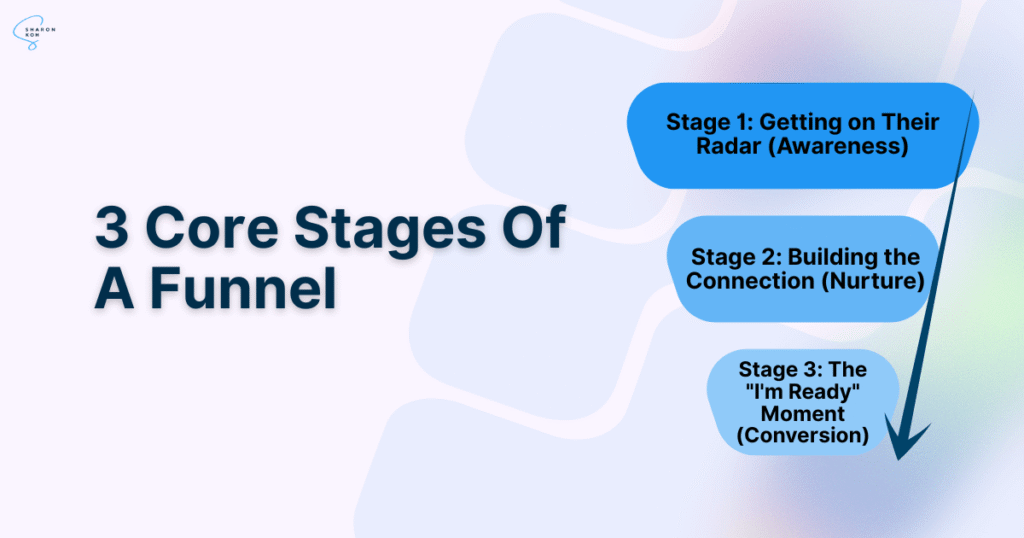
Before we get into each stage, if you want a deeper breakdown of how these stages work together to move leads through your funnel, check out how to master each coaching funnel stage.
Stage 1: Getting on Their Radar (Awareness)
This is when someone first comes across you.
Maybe they saw your post while scrolling Instagram, found your blog on Google, or clicked a Pin on Pinterest.
Want to maximize your Pinterest traffic? Here’s how to turn every blog post into multiple high-performing pins that drive consistent visitors to your funnel.
Your only job here? Make them go, “Hmm, interesting.”
What works:
- Share quick stories about how your clients went from losing to winning
- Give away something small but useful, like a checklist, a mini-guide, or even a quiz
- Make it super-easy to know what to do next with a call-to-action button: “Grab your free guide here”
Stage 2: Building the Connection (Nurture)
Once they’ve downloaded your thing or joined your email list, now you actually talk to them more personally.
This is where you stop being a stranger and start becoming someone they could trust.
Here’s how:
- Send valuable, helpful emails. One idea, one story, one thing they can really use to practice on.
- Don’t be perfect. Share the times you messed up. People love knowing you’re real, not some untouchable guru.
- Ask them questions like, ‘What’s your biggest challenge right now?’ It gets them thinking about their situation – and about you as someone who understands.”
Your emails should educate and build trust before you make your offer. The coaches who convert best aren’t the ones with the slickest pitches – they’re the ones who know how to sell coaching services naturally so leads feel excited, not pressured.
I’ve also tested the top options and break down which ones work best for different budgets and business stages in my guide to the best email sequence tools for coaches.
Stage 3: The “I’m Ready” Moment (Conversion)
This is when they’ve been hanging around, reading your emails, nodding along… and now they’re actually considering working with you.
What to do:
- Give them one clear option. Book a call. Join your program. Buy your course. Don’t confuse them with ten different choices. Don’t confuse them with ten different choices. One clear CTA works best
- Show them proof it works, client wins, testimonials, screenshots, whatever you’ve got.
- And hey, if they’re not ready yet? That’s fine. Let them know there’s no pressure.
You’ve seen how each stage of a funnel guides your audience step by step – but what truly moves them to say yes isn’t just structure.
It’s psychology.
In 5 Funnel Psychology Secrets Every Coach Should Know, I break down the emotional triggers behind why people buy – and how to weave them smoothly into your own funnel.
How to Create a Converting Business Coaching Funnel in 5 Easy Steps
Alright, here’s the exact process I use (and still recommend to clients):
1. Get clear on what you’re actually selling
Don’t just say “business coaching” or “I help entrepreneurs grow.” That’s like saying “I sell food”, okay, but what kind?
Be extremely specific about what actually changes for people. Like:
“I help service-based coaches go from $3K months to $10K months in 90 days- without creating a single new offer or working weekends.”
See the difference? One makes people go “oh, interesting.” The other makes them go “wait, that’s literally me. How?”
The more specific you are about the before and after, the easier it is for the right people to say “yes, that’s exactly what I need.”
2. Create something small they can grab right now
This is your freebie- the thing that gets people to raise their hand and say “yeah, I want that.”
For business coaches, think: a quick audit, a scorecard, a mini roadmap. Something they can use right now to spot what’s working or what’s not. Keep it laser-focused on one specific win.
Like:
- “The 10-Minute Revenue Audit”
- “5 Questions to Know If You’re Ready to Scale”
- “The Profitable Offer Checklist (Takes 15-Minutes)”
Not a massive workbook or a 37-page guide nobody finishes. Just one quick thing that makes them go “oh wow, this actually helped.”
When they get a quick win from your freebie, they start thinking “okay, what else can this person help me with?”
3. Make a simple page where they can get it
One page with one headline. Short explanation of what they’re getting. One button to download it.
That’s it! Don’t overcomplicate things.
Don’t add ten sections or a dozen colors. Clean and clear wins every time.
Remember, easy on the eyes, easy to digest!
4. Write a few emails to keep the conversation going
You don’t need 37 emails. Start with just 3 to 5:
- Email 1: Welcome them, deliver what you have promised
- Email 2-3: Share something useful or tell a story they can relate to and/or quick tips in your area of expertise
- Email 4-5: Let them know how they can work with you if they are curious. But don’t be salesy, nobody likes a salesy person.
5. Check what’s working (and what’s not)
Every couple of weeks, check the numbers on your dashboard.
Which email did people actually open? Where are they dropping off?
You don’t need to be a data genius, just notice the patterns and adjust.
These steps might seem simple, but they make a massive difference when you track what’s working and what’s not.
Common Funnel Mistakes Business Coaches Make (and How to Fix Them)
Look, I’ve messed up basically every part of this at some point.
So if you’re feeling lost, we’re good, no judgement here, you’re in good company.
Here are the three biggest mistakes I see (and definitely made myself too).
1. Overcomplicating everything
When you’re starting out, it’s so tempting to create five different freebies, three mini-courses, and a dozen email sequences because you think more options = more sales.
And honestly? It confuses you too.
Stick to one simple path: free thing -> helpful emails -> one clear way to work with you.
That’s it!
2. Sounding like a marketing bot
Your emails shouldn’t sound like this: ‘Dear valued subscriber, we hope this message finds you well…’
They should sound like this: ‘Hey! Remember that thing you downloaded last week? Here’s why it matters.
Write like you’re texting a friend.
Use “I” and “you.”
Throw in your weird sense of humor and slang!
Talk about the time you wore your pajamas pants and accidentally stood up during an online meeting.
People love real stories, real talk and a real you.
People buy from people, so…you are allowed to be you!
3. Giving up after one email
Here’s the hard truth that people do not like to hear: most people aren’t ready to buy the first time they hear from you.
Maybe they’re busy.
Or, maybe they need to think about it.
Sometimes, maybe, they just forgot.
So keep showing up, not in an annoying “BUY NOW” way, but in a “hey, here’s something helpful” way.
The follow-up is where the conversion happens.
Once I fixed these three things? My funnel went from barely working to bringing in clients while I go offline and spend some quality time with myself and kiddo.
Get the Step-by-Step Funnel Checklist
(It’s Free & deliver to your inbox)!
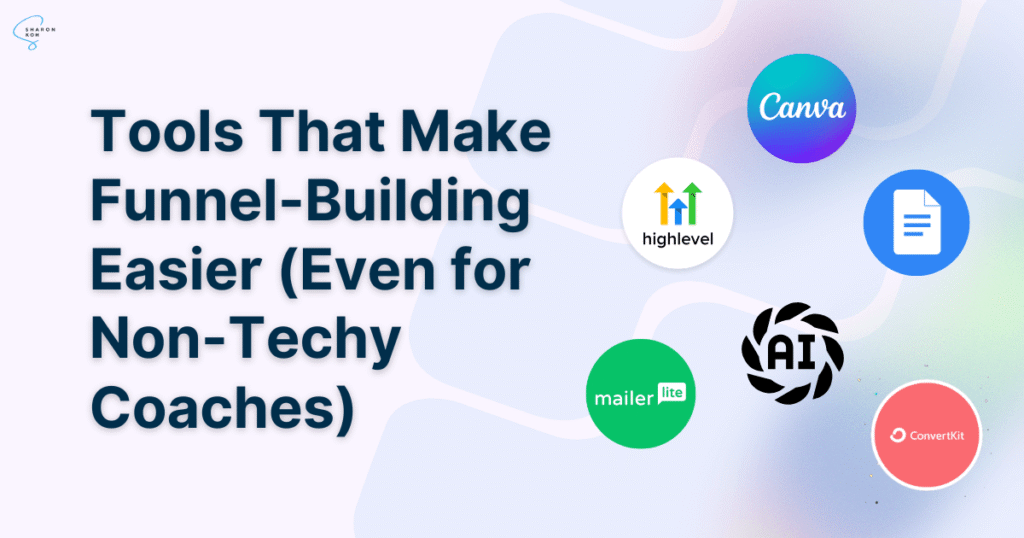
Tools That Make Funnel-Building Easier (Even for Non-Techy Coaches)
Okay, honestly, you don’t need to be a tech wizard to set this up.
Here’s what works (and what I use and recommend).
1. GoHighLevel (GHL)
This one’s like an all-in-one toolbox.
Landing pages, emails, automation, it’s all there.
A bit of a learning curve, but once you get it, you’re set.
If you get overwhelmed by this, hiring a tech VA for a few hours can help, but most coaches figure it out on their own if they have the time to. (Not sure which platform to pick? Here’s my honest comparison of GoHighLevel vs Systeme.io for coaches.)
2. Canva
For making your freebies look decent without hiring a designer.
Seriously, even if you think you have zero design skills, Canva makes it pretty hard to mess up.
I create most of my designs here
3. ConvertKit or MailerLite
If you’re just starting and want something simple for emails, these are solid.
They are not overwhelming and not expensive, pretty straightforward to use as well.
4. Google Docs
Before you build anything, write it out here first.
Plan your emails, sketch your ideas, get your thoughts in order.
It’s free and you already know how to use it.
If not, YouTube has tons of tutorials. But honestly, if you can write an email, you can use Google Docs
5. ChatGPT or Claude
Great for bouncing ideas around, doing the heavy-lifting for you.
But remember, use it as a tool, not your replacement, use it to help you write, not to write for you.
Your voice matters here, people buy from people, not AI.
Bottom line?
Start with one or two tools.
You can always add more later.
Don’t let “I need the perfect tech stack” stop you from actually getting started.
Don’t overcomplicate it, friend, action over perfection
How to Know If Your Funnel Is Working
Here’s a quick reality check:

For a deeper breakdown of each metric and what the numbers should actually look like, check out the 7 funnel results every coach should track.
If your numbers look low, don’t freak out just yet.
Do some digging.
Maybe your freebie isn’t clear enough.
Maybe your subject lines need more personality or curiosity.
“Optimization” is just a fancy word for “keep improving small stuff until the numbers go up.”
(By the way, these numbers come from recent reports by HubSpot, Hostinger, and SeedProd if you want to geek out on the data.)
Final Thoughts- Your Funnel Is a Conversation, Not a Chase
Here’s what I wish someone told me when I first started: a funnel isn’t some cold, robotic system.
It’s just… a conversation.
Between you and the people you’re meant to help.
When you build it with real care and heart, when you think about what someone needs to hear at each step, you stop feeling like an annoying salesperson.
Instead, you’re just walking alongside them, showing them the way.
The best salespeople understands you, but gives you space to decide. They guide without pushing you.
So start small. Like, really small.
One simple page.
A few honest emails with your stories and valuable tips.
One thing they can say yes to easily.
That’s enough. You can always add more later.
You don’t need to know all the fancy tech stuff.
In fact, you don’t need to be perfect.
You just need to care enough to make things super clear and super easy for your people.
The right people are already out there looking for someone like you.
And your job? Just make it easy for them to find you and know you’re the one who can help them.
Summary/ Takeaways:
Many coaches burn out from constantly chasing clients on social media, cold dm-ing, and relentless follow-ups, and honestly, it gets exhausting.
And, a sales funnel fixes all that by creating a simple path that turns strangers into paying clients even when you’re offline.
Here’s what you need: one clear freebie, 3 to 5 honest emails that build trust, and one straightforward offer.
That’s it.
No fancy tech skills required here.
The three stages are really simple: get people’s attention (awareness), build a real connection through helpful emails (nurture), and give them one easy way to work with you (conversion).
Common mistakes?
Overcomplicating things, sounding like AI, and giving up after only one email.
Improve on these, and your funnel becomes your best assistant by bringing in clients while you live your life, offline.
Start small. One page. A few emails. One offer.
You can always add more later on.
Want to learn how to build all this yourself with expert support? I’ve tested and reviewed the 3 best funnel building courses for coaches -including the one I personally took. Some give you a full year of coaching, others are free or budget-friendly. Pick what fits your time and wallet.
Your future clients are already looking for you, just make it super easy for them to find you.
Once you know what you’re selling and who it’s for, figure out which funnel type actually fits your coaching business. Then you gotta map out how leads move through the thing. I’ve got a list of funnel mapping tools for coaches that’ll help you visualize the whole flow before you dive into building.
Ready to turn that funnel plan into something real? Head over to my easy 5-step guide on how to create a converting business coaching funnel. It walks you through the whole process-defining your offer, building pages, setting up automated emails that works while you sleep.
And if you already have a funnel up and running but it’s not bringing in clients the way you expected, don’t panic. You might just have a few hidden roadblocks slowing things down. In this post on 3 Funnel Bottlenecks That Are Killing Your Conversions, I show you where most funnels break – and how to fix them fast.
Get the Step-by-Step Funnel Checklist
(It’s Free & deliver to your inbox)!
FAQ:
Wait, do I really need a funnel? Can’t I just post on Instagram?
You can, but here’s the thing: posting on Instagram means you have to constantly check your DMs. A funnel works even when you’re sleeping, hanging out with your family, or binge-watching your favorite show. It’s like having a helpful assistant who talks to people for you.
I’m not good with tech stuff. Will I be able to do this?
If you can send an email and use Google, you can build a funnel. Seriously. You don’t need to be a tech genius. Start with free tools like Canva and Google Docs. Write everything out first, then just follow the steps. Tons of coaches who “aren’t techy” have done this.
How long will this take me to set up?
If you keep it simple? Maybe a weekend. A few hours to create your freebie, an hour or two to make a simple page, and a couple hours to write 3-5 emails. Don’t try to make it perfect—just get it done. You can always make it prettier later.
What if nobody downloads my freebie?
Then your freebie might not be solving a problem people actually have. Ask yourself: “Would I want this?” or “Does this solve one specific annoying thing?” Make it about one quick win, not everything. Like “5-Minute Morning Reset” instead of “Complete Guide to Your Entire Life.”
How many emails is too many emails? Will I annoy people?
Start with just 3-5 emails. You’re not annoying people if you’re actually helping them. Think of it like texting a friend with useful tips, not spamming them with “BUY MY STUFF.” If they don’t want your emails anymore, they can unsubscribe. That’s totally okay.
What do I even write in these emails?
Email 1: “Hey! Here’s that thing I promised you.”
Email 2-3: Share a quick story, a tip they can use today, or a mistake you made
Email 4-5: “By the way, if you want more help, here’s how we can work together”
That’s it. Write like you’re talking to one person, not a crowd.
People download my stuff but nobody books a call. What’s wrong?
Maybe they’re not ready yet. Most people need time to think about it. Keep sending helpful emails, but don’t disappear after the freebie. Some people take weeks or even months before they’re ready to say yes. That’s normal.
Do I need to spend money on fancy software?
Nope. Start with free stuff: Google Docs to plan, Canva to design, MailerLite for emails (free for up to 1,000 people). Once you’re making money from your funnel, then you can upgrade. Eventually you might want to upgrade your tools, but only after your funnel is bringing in clients.
How do I know if it’s actually working?
Look at these things every couple weeks:
Are people downloading your freebie? (10-15% of visitors is good)
Are they opening your emails? (35-45% is solid)
Are they booking calls or asking questions?
If the numbers are low, change one thing and wait. Don’t change everything at once or you won’t know what worked.
What if I build this and it doesn’t work right away?
Then you improve it. Nobody gets it perfect the first time. Maybe your headline needs work. Maybe your emails are too long. Maybe your offer isn’t clear. It’s like cooking, you taste and adjust. Keep going, keep showing up. The coaches who succeed aren’t the ones who get it right immediately. They’re the ones who don’t give up. This isn’t overnight success territory. Give time, time, do 1% better everyday.
Can I still talk to people on social media if I have a funnel?
Of course! Your funnel doesn’t replace you, it helps you. You can still show up on Instagram or Facebook. But now, when someone’s interested, you point them to your freebie instead of manually DMing 50 people the same thing over and over.
I’m scared people will judge my funnel or think it’s not good enough.
The people who judge aren’t your people anyway. Your future clients just want to know if you can help them. They don’t care if your landing page has fancy graphics or if your emails are “perfect.” They care that you get them and can solve their problem. Done is better than perfect.
How do I know what’s affecting my funnel conversion rate?
Audit your funnel. Takes 30 minutes. You’ll see exactly where leads are leaving – then you fix that first, not everything else.
What’s the best funnel template for coaches?
It depends on your business stage. If you’re just starting out or validating your offer, Systeme.io’s free plan gives you everything you need without spending a dime. I break down all three options in my guide on the best funnel templates for coaches.
One Last Question: What If This Actually Worked?
What if, six months from now, you had clients booking calls with you while you slept?
What if you never had to send another cold DM or wonder where your next client was coming from?
That’s what a simple funnel can do for you.
Ready to build yours? Grab my free funnel checklist and I’ll walk you through the first steps.
Want more? I’ve got other posts that dive deeper into each of these steps.